
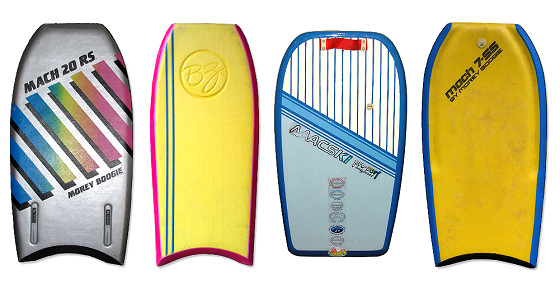
Rob Beaton owns one of the most complete collections of vintage bodyboards in the world.
The developer of VintageBodyboards.com loves to study the history of boogie boards and has been purchasing old-school models for years.
"Many of the bodyboards pictured on my website are from my personal collection, but I have got photo contributions from all over the world," Beaton told SurferToday.
"Special thanks to Shane Griffiths in Australia and Henry Marfleet and Matty Chappas in the UK."
Vintage bodyboards are super fun and make us leap forward to the past. Isn't retro bodyboarding the old future? Confused? Take a look at what comes next.
Bodyboarding was invented by Tom Morey on July 9, 1971. The first decades of prone riding were made with unusual materials and rough designs.
In fact, boogie boarding was more a question of having fun in the white water and less a matter of performance.
That is why the most interesting period in bodyboard shaping is clearly 1972-1992. In 20 years, many things have changed, and you can clearly spot the differences.
Vintage bodyboards are a great way of experiencing how the past of bodyboarding evolved to high-performance aerial wave riding.
Rob Beaton's vintage bodyboards have their own stories. Check out the most innovative bodyboard models of the 1972-1992 period:
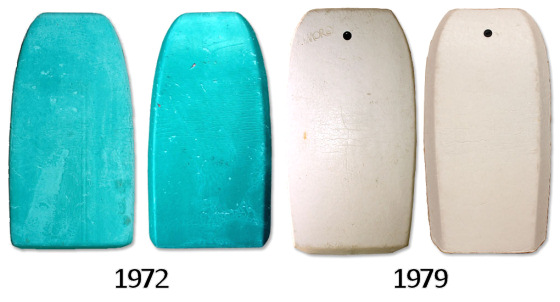
1972 | Morey Boogie | Boogie Board | Flexible, 70/30 Rails
"One of the very first boogie boards. This board was acquired from Tom Morey in 1972 by Rus Calisch, who was then the advertising director for International Surfing Magazine. It even predates the Morey Boogie name, which was trademarked in 1973. The board measures about 47" long, 25" wide, 2.25" thick, and 3.75 lbs. Early boards like this allowed the rider to feel the wave through the board much more than with today's stiffer, improved bodyboards."
1974 | Morey Boogie | Boogie Board | Morey Branded
"This very early Boogie Board was likely personally shaped by Tom Morey himself. This board pre-dates the 132BE model that uses colored skins. The Morey stamp was made with an actual iron brand made by Tom. He and Bobby Szabad (who later created BZ) worked as a team to hand stamp each board. Judging by the thin layer of brownish-yellow glue along the edges of the skins, this board was made before Morey began heat-welding boards."
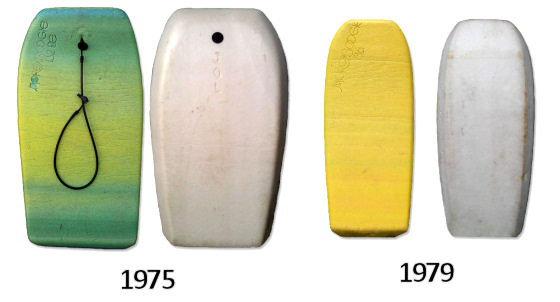
1975 | Morey Boogie | 132 B.E. | Square Tail
"The first production run of Morey Boogie hit the market in 1975. The 132 B.E. was hand-shaped, and it shows. There is an obvious lack of symmetry between the two rails. The 'B.E.' stands for "Baha'i Era," indicating that the model number corresponds with the Baha'i calendar (i.e., 132 BE = 1975). Thus, the 132 B.E. was produced in 1975."
1979 | Morey Boogie | Mini 136 | Small Scale
"Among the first generation of original Morey Boogies to hit the market, the Mini 136 was a small-scale version of its big brother from the same year. Measuring approximately 36" long and 14.5" wide, the Mini 136 was primarily made as a board for kids and smaller riders. Small-scale versions like this date back as early as 1975 with the Mini 132. Like other early Morey boards, the construction consisted of a shaped foam core with a polyethylene top skin."
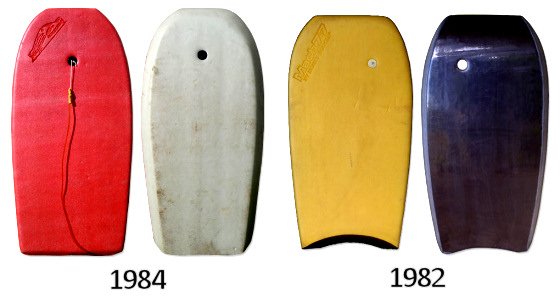
1984 | Bronzed Aussie | Bronzed Aussie | Double Skin Construction
"The Bronzed Aussie was a bodyboard developed in Australia by World Pro Surfing champions Ian Cairns and Peter Townend. Similar to the numbered Morey 'Original' series, the Bronzed Aussie featured a double skin construction for greater rigidity, better performance, and super quick response."
1982 | Morey Boogie | Mach 7-7 | Ion Speed Slick Bottom
"The Mach 7-7 introduced a radical, new concept: the 'ion speed' slick bottom. Its groundbreaking design forever changed the face of bodyboarding, offering unprecedented speed (especially compared to other boards of the era) and ushering in a whole new generation of high-tech bodyboards with slick bottoms. Only produced for two years, the first generation Mach 7-7 featured 70/30 rails and a black bottom. The black bottom was prone to bubbling and was later changed to the more familiar orange color."
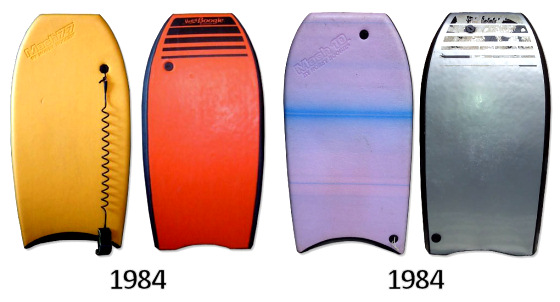
1984 | Morey Boogie | Mach 7-7 | Crescent Tail, 60/40 Rails
"Behold the most recognized and popular bodyboard of all time. The ubiquitous Mach 7-7 was the flagship of the Morey Boogie line and the de facto standard by which all other bodyboards were measured throughout the 1980s. The board featured the perfect combination of versatility and flexibility, and it was affordable enough for most bodyboarders to use the same equipment that all the pros were using. This second generation of Mach 7-7 featured an orange bottom with the black bar decal and the embossed logo."
1984 | Morey Boogie | Mach 10 | No Wingers
"When most people think of the classic Mach 10, winger rails come to mind. However, the first generation Mach 10, shown here, was actually wingerless. Wingers didn't appear until the second generation. The Mach 10 came in two different colors - purple with a blue stripe (shown) and, less commonly, blue with a pink stripe. Offered for two years, the original Mach 10 featured an overall larger template and three graphite stringers. The template was later used as the inspiration for the Mach 20 XL in 1989."
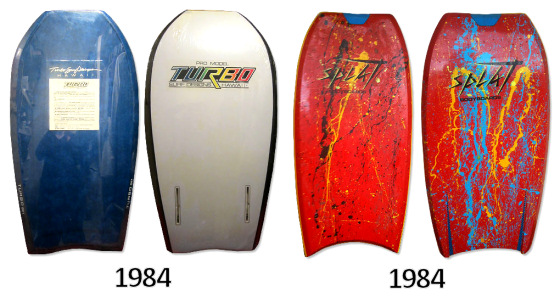
1984 | Turbo Surf Designs | Turbo SE1 | Vinyl Deck, Fin Boxes
"In their second year of business, Turbo Surf Designs introduced their SE series. The Special Edition series came standard with a Turboskin (vinyl) deck, a Turbo high-impact plastic bottom, sandwich construction for superior stiffness, and inset fin boxes. The SE1 was an 'all-around bodyboard, extra stiff for knee riding and standup.' Turbo was offering solid color vinyl decks in 1984 and would introduce their trademark graphics a year later."
1984 | Splat | Splat | Channels
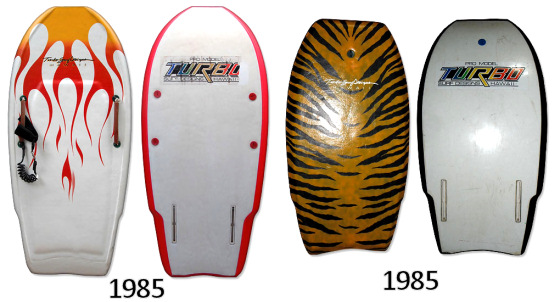
1985 | Turbo Surf Designs | Super Turbo | Long Scale, Narrow Nose
"With a length of 48", the Super Turbo was the longest bodyboard in the Turbo Surf Designs lineup. The Super Turbo was built with knee riding in mind and featured not only a full side-to-side and full-length plastic plate for durability but also padding to cushion the knees and chest for comfort. This narrow-nose version of this model was also known as "Turbo 2". This particular board features brand new rails installed by Ken Brown at KenuHawaii, who specializes in this type of reconditioning work."
1985 | Turbo Surf Designs | Turbo 2 | Wingers, Fin Boxes
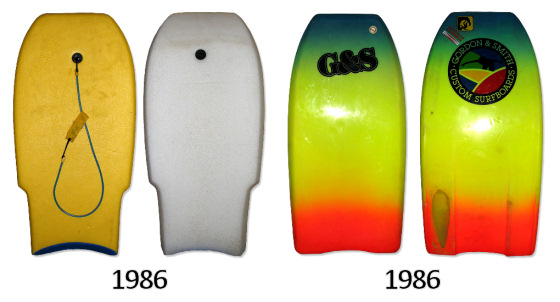
1986 | Morey Boogie | Aussie II | Contoured Wingers
"The second generation Aussie II improved upon the original with the addition of contoured wingers and crescent tail. Both the Aussie and Aussie II were branded with the "Aussie" logo, but the Aussie II can be identified by its full-scale length (41"). As one of the most common boards for beginners, the Aussie II was always a great source of embarrassment for bodyboarders hoping to progress to better equipment. Insults of "What kind of board do you have, an Aussie?" were commonplace in the late 1980s. Like other low-end models, the Aussie II lacked a bottom skin."
1986 | Gordon & Smith | Fiberglass | Channels
"Gordon & Smith entered the thriving bodyboard market in the mid-1980s with a short-lived line of fiberglass bodyboards. Crafting quality surfboards since 1959, G&S applied their longtime knowledge to build several dozen slick-looking airbrushed bodyboards with channels. The downsides were evident: the lack of padding made for a less forgiving board, and fiberglass is susceptible to dings. Most notably, the complete lack of flex worked against what many considered to be an essential characteristic of bodyboards."
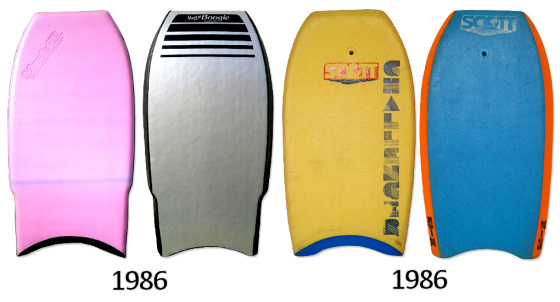
1986 | Morey Boogie | Mach 10 | Winger Rails, Graphite Stringers
"The Mach 10 typically came in two different colors - purple or blue - but some of these boards appeared to be more pink than anything else. All generations of Mach 10 featured three graphite stringers, but a second-generation Mach 10 like this one featured winger rails to help loosen up its turning ability. The wingers on the second generation were slight as compared to the accentuated wingers on later generations."
1986 | Scott Hawaii | Challenger X-15 | HDPE Bottom
"When it was introduced in the mid-1980s, the Challenger X-15 featured a high-density polyethylene bottom. This was later upgraded to feature Scott's special 'Speedskin' slick bottom. The Challenger X-15 also boasted a 2.5 lb polyethylene core -- a higher density than most other boards on the market at the time."
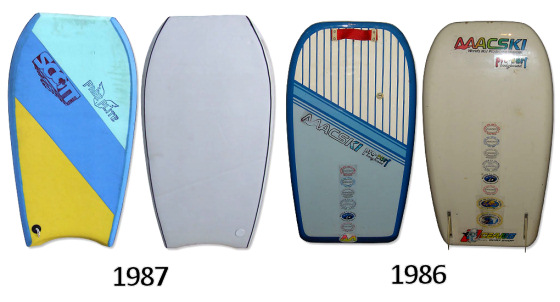
1987 | Scott Hawaii | Free Flite | Top and Bottom Double Rails
"The Free Flite from Scott Hawaii featured double rails on both the top and bottom for added stiffness."
1986 | MacSki | Pro-Surf | Twin Skegs
"Based in South Africa, MacSki produced a popular line of bodyboard in the early to mid-1980s. The board is rigid with an epoxy-like construction, and it features twin fins and a built-in handle. During that era, South African bodyboard contests had specific divisions based on the type of bodyboard you were riding - foam boards were considered 'soft core,' and Macski style boards were considered 'hard core.'"
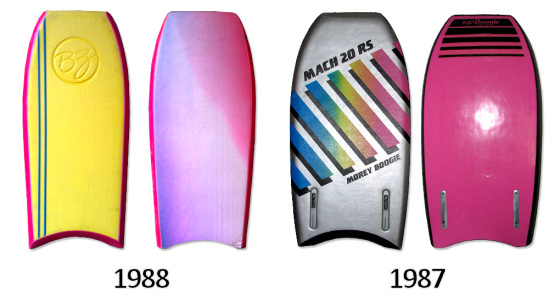
1987 | Morey Boogie | Mach 20 RS | Retractable Skegs
"This first-generation Mach 20 RS was considered the top of the Morey Boogie line. The unique retractable skegs could be raised and lowered using the levers on the deck. The skegs lock gently into place with plenty of give in case they collide with a stationary object like rocks or a swimmer. Advertisements claimed that skegs offered 'hard edge control on steep, hollow waves' that one or both skegs could be engaged before takeoff, and that the skegs could also be left up 'for speed and spinners.'"
1988 | BZ | Diamond Stinger | Slick Rails and Tail
"The Diamond Stinger was one of BZ's higher-end models of the era. Its most notable features were BZ's trademark Diamond Rails with slick skin on both chines. The first generation of Diamond Stinger also included a slick skin crescent tail but was not branded with the model name."
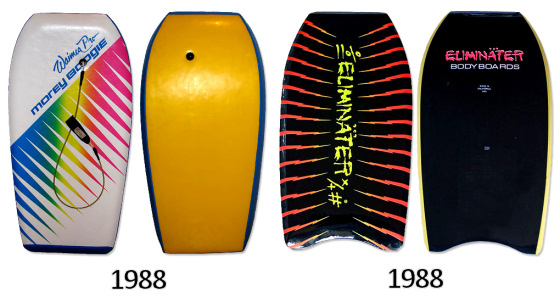
1988 | Morey Boogie | Waimea Pro | Vinyl Deck, Graphics
"The Waimea Pro was well known for its vibrant graphics printed on a vinyl deck. The vinyl was laminated on top of HDPE using a patented tri-lamination process. The aesthetic benefit of cool graphics came at the cost of a heavier board. Aside from its colorful vinyl deck, the Waimea Pro was notably similar to the Mach 6 - both boards had the same dimensions, a square tail, and a non-Surlyn slick skin. The graphics on the Waimea Pro changed annually. The second generation of Waimea Pro (shown here) featured a rainbow-colored spike design."
1988 | Eliminater | Wave Blaster | Rad Graphics
"The Eliminater Wave Blaster featured an Arcel core and was one of the stiffer boards of its day. The black bottoms posed a problem with bubbling when exposed to prolonged sunlight. Eliminater Bodyboards were shaped in Costa Mesa, CA by Kevin R. Wood, and team riders were Bill Hebner and Joe Foster."
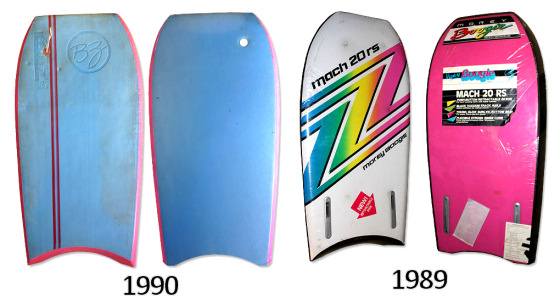
1990 | BZ | Ben Board | Slick Rails, Chines, and Tail
"Endorsed by the legendary Ben Severson, the Ben Board was highly anticipated and hailed as one of the best high-performance boards of the era. Featuring an Arcel core, a killer template, and slick rails, chines, and tail, it was the flagship of the BZ lineup. The first generation Ben Boards were stamped with a 3-digit serial number."
1989 | Morey Boogie | Mach 20 RS | Retractable Skegs
"This second-generation Mach 20 RS is remarkably still in the original packaging. The label on the deck points out the 'New! Retractable fins'. The flyer under the wrapper boasts features such as push-button retractable skegs, black Vacuum-Track rails, a tough, slick Surlyn bottom skin, and a flexible, strong inner core. An unusual feature of this particular board is the white deck - the Mach 20 RS typically featured a silver deck."
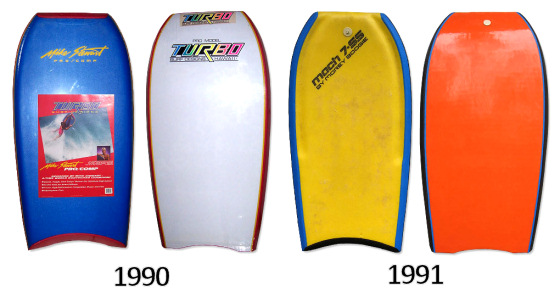
1990 | Turbo Surf Designs | Mike Stewart Pro/Comp | Polyethylene Core, Surlyn Bottom
"The Mike Stewart Pro/Comp was a vastly different board from the others in the Turbo line. Rather than a stiff, hard polystyrene bottom, the materials were more consistent with Morey Boogie's line. It is no coincidence - the Turbo name was licensed to Morey Boogie to create this model. This variation features a straight logo on the deck."
1991 | Morey Boogie | Mach 7-SS | Double 50/50 Rails, Grooved Chines
"The Mach 7-SS took the tried-and-true Mach 7-7 and kicked it up a notch. According to ads, riding this new design would reportedly leave riders 'super-stoked' (hence 'SS'). The second generation Mach 7-SS eliminated the oversized rail grips of the earlier generation in favor of grooved ridges along the chines."