
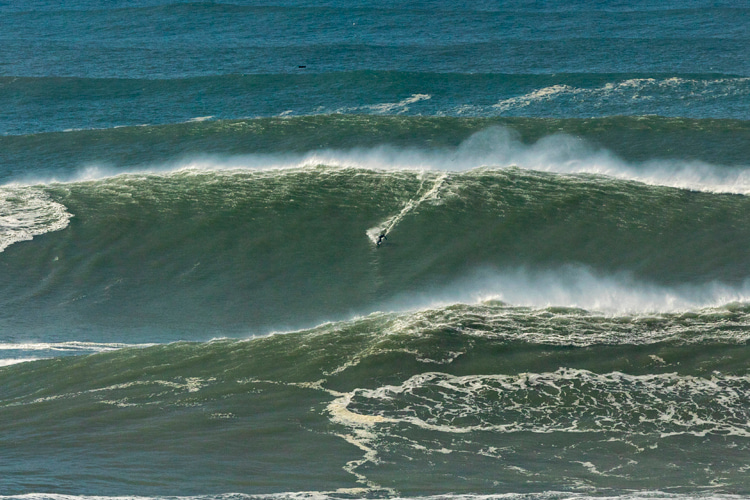
The Portuguese town of Nazaré can deliver 100-foot (30.4 meters) waves. So, how can we explain the Nazaré Canyon geomorphologic phenomenon?
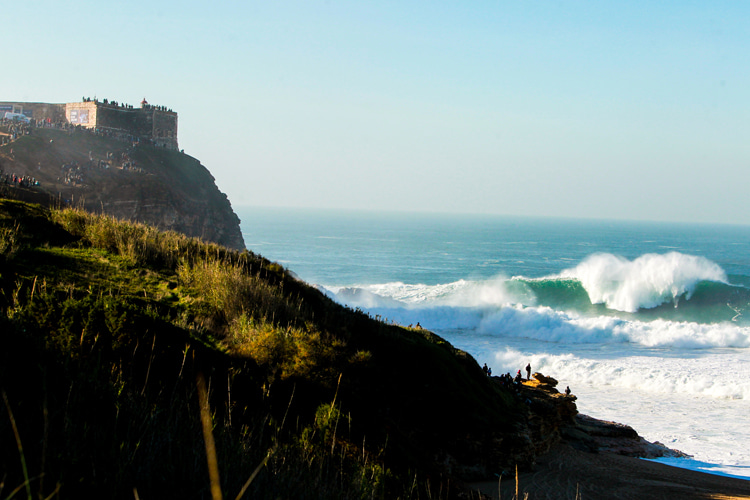
In the 16th century, Portuguese people and the army protected Nazaré from pirate attacks in the Promontório do Sítio, the cliff-top area 110 meters above the beach.
Today, it is possible to witness the Atlantic Ocean's power in its full glory from this unique site.
If you turn your face toward the saltwater from the local lighthouse, you can easily spot the famous waves that have transformed the quiet village into a world-renowned big wave surfing arena.
What are the mechanics of the Nazaré Canyon? Is there a clear explanation for the size of the local waves?
First, it's important to highlight the most common swell direction in the region - west and northwest.
The prevailing winds blow from the northwest and southwest, with the latter associated with atmospheric depressions.
Given its east-west orientation, the headland interferes with the winds and dramatically influences the sea's dynamic conditions near the beach.
The headland divides the shoreline into two beaches: in the north, there's Praia do Norte; in the south, you'll find Praia da Nazaré facing the local bay.
The Underwater Canyon
The Nazaré Canyon is the largest underwater canyon in Europe and one of the largest in the world.
It is located 100 kilometers north of Lisbon, with a direction ENE-WSW in the upper and E-W in the middle and lower parts.
The canyon head is located very close to the shore, reaches 20 meters in depth, and is only a few meters away from the beach.
This large submarine valley leads to the Iberian Abyssal Plain, which is located around 210 kilometers off the Nazaré coast at a water depth of 5,000 meters.
But how and why do giant waves suddenly arrive at this beach break?
According to the Portuguese Hydrographic Institute, the arrival of a powerful W-NW swell has the following consequences:
- Wave Refraction: The refraction of the wave, due to the difference in depth between the continental shelf and the submarine canyon, leads to a change in its direction and speed;
- Overtopping a Topographic Barrier (steep vertical variation): The abrupt depth reduction leads to a shoaling effect on the wave (reduction of wavelength and increase of wave height). This effect occurs gradually with the approach of a wave to the shore;
- Constructive Sum: Positive interference between the wave traveling from the canyon and the wave propagating across the northern continental shelf. This effect promotes a new increase in wave height at the intersection of the two wavefronts;
- Litoral Drift: The wave propagation promotes a current flowing along the beach in a northerly direction, which deflects offshore near the cape, acting as a topographic barrier. This current is enhanced by the water pile-up in the cove. The current, flowing in the opposite direction to wave propagation, intercepts the wavefronts, leading to an additional increase in the shoaling effect. The combined effect of these processes significantly increases wave height, which can reach much higher levels than those observed offshore. These waves break when their height is approximately equal to the local water depth. The results are spectacular, with giant waves breaking on the cliffs of the headland;
But how and why do giant waves suddenly arrive at this beach break?
A few miles off the coast of Nazaré, there are drastic differences in depth between the continental shelf and the canyon.
When swell heads to shore, it is quickly amplified where the two geomorphologic variables meet, causing the formation of big waves.
Furthermore, water current is channeled along the shore - from North to South - in the direction of the incoming waves, additionally contributing to wave height.
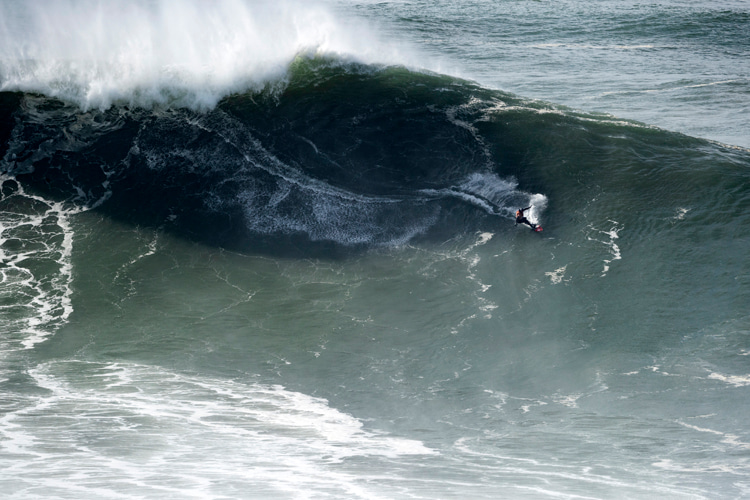
Nazaré holds three Guinness World Records for the largest waves ever surfed by a male (Rodrigo Koxa) surfer, a female (Maya Gabeira) surfer, and a kitesurfer (Nuno "Stru" Figueiredo).
In conclusion, the difference in depths increases wave height, the canyon increases and converges the swell, and the local water current helps shape the world's biggest wave.
Last but least, add perfect wind speed and direction into the equation, and Nazaré greets you at its finest.
Summary of Variables
- Swell Refraction: The difference in depths between the continental shelf and the canyon changes swell speed and direction;
- Rapid Depth Reduction: wave size builds gradually;
- Converging Wave: The wave from the canyon and the wave from the continental shelf meet and form a higher one;
- Local Water Channel: A seashore channel drives water toward the incoming waves to increase their height;
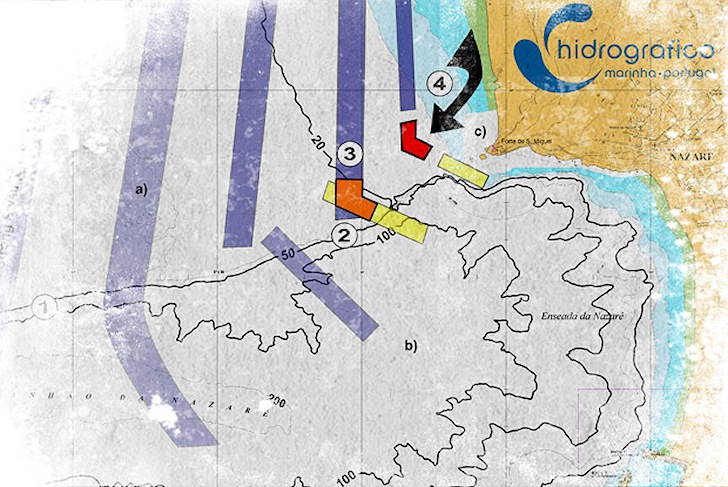
a) Wave Fronts;
b) Head of the Nazaré Canyon;
c) Praia do Norte;