|
Friday, 03 February 2012 14:54 |
|

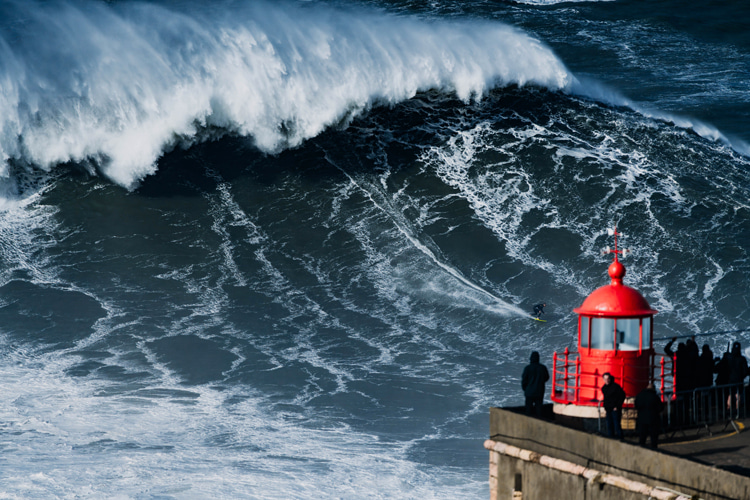
The winners of the Australia's Surfing Life Oakley Big Wave Awards will be announced at Simmer on the Bay, Dawes Point, Sydney, on February 8th, 2012. The finalists of the Biggest Wave, Biggest Slab and Biggest Paddle-in Ride have been named and are available at www.bigwaveawards.com.au.
Big waves and stunning images make the decisive list of Australia's most prestigious big surfing challenge. Mark Mathews, Marti Paradisis, Jamie Mitchell, Ryan Hipwood, Chris Shanahan, Ben Rufus, Damien Warr and Tyler Hollmer Cross are some of the surfers that may lift the title and grab the $35,000 in prizemoney.
"We felt the surfers themselves were the best judges of each other’s performances," explained event co-ordinator Nick Carroll. "They know these wild surf zones better than anyone else and they have a clear view of the challenge involved. We were stoked with the way they responded! They’ve come up with an epic group of finalists, that’s for sure."
|
|
Last Updated on Friday, 03 February 2012 15:00 |
|
Read more...
|
|
|
Thursday, 02 February 2012 10:46 |
|

John John Florence has conquered the 2012 Volcom Pipe Pro, for the second consecutive year, at Banzai Pipeline, Hawaii. John Florence sealed the victory in the last 10-seconds of the 35-minute final against Jamie O'Brien, Kai Barger, and Nate Yeomans.
O'Brien held the lead for the majority of the final, only to see the top spot disappear in the last minute of the heat. With a minute to go, Florence paddled over and congratulated O'Brien. Watch the final highlights, here.
Then a dark line on the horizon caught his eye. One last wave stacked up on the Pipeline reef. Florence clawed his way past Jamie, over the ledge, under the lip and into the heat-winning tube ride - a 9.93 - to claim the $20,000 first prize and a custom warrior helmet trophy.
"I wrote myself off half way through," said Florence. "Kai and Jamie both had nines and eights. Jamie had two nines. I can't believe it. Here at Pipe anything can happen. I surfed my first heat, then had my hand (injury) and tweaked my neck really bad and that was killing me. So I was seriously considering not continuing on. I got some work done on my neck, taped my hand up and it all worked out."
|
|
Last Updated on Thursday, 02 February 2012 10:57 |
|
Read more...
|
|
Wednesday, 01 February 2012 15:50 |
|

It's 6th June 1944, in Normandy, France. The Allied troops prepare the largest amphibious operation in history, against Nazi Germany. D-Day has come. While the infantry and armoured divisions wait for the green light, the weather charts are constantly updated.
A recently declassified dossier shows that swell, surf height and wind were crucial variables taken in consideration in the Operation Neptune. It involved tides, winds, waves, visibility both from the air and the sea stand-point, and the combined employment of land, air and sea forces in the highest degree of intimacy and in contact with conditions which could not and cannot be fully foreseen.
On the 1st February, the British Admiralty's Naval Meteorological Service activated a Swell Forecast Section in order to get accurate wave predictions for D-Day, the Big Storm (19th-22nd June 1944) and over-the-beach supply operations following the destruction of the artificial harbor at the Omaha beachhead.
Two years before the Operation Overlord (Normandy landings) and Operation Neptune, Franklyn Roosevelt, the US President at the time, sent a message to Winston Churchill, the British Prime Minister, showing his concern. "...bad surf on the Atlantic beaches is a calculated risk".
Nearly one million equipped troops were extremely sensitive to wave action. It would not be easy to deploy everyone and everything, quickly and efficiently. The report from Charles C. Bates, retired Lieutenant Colonel of the U.S. Air Force tells "it needed a four-day period of low seas".
|
|
Read more...
|
|
|
|
|
«StartPrev12345678910NextEnd»
|
|
Page 1 of 748 |